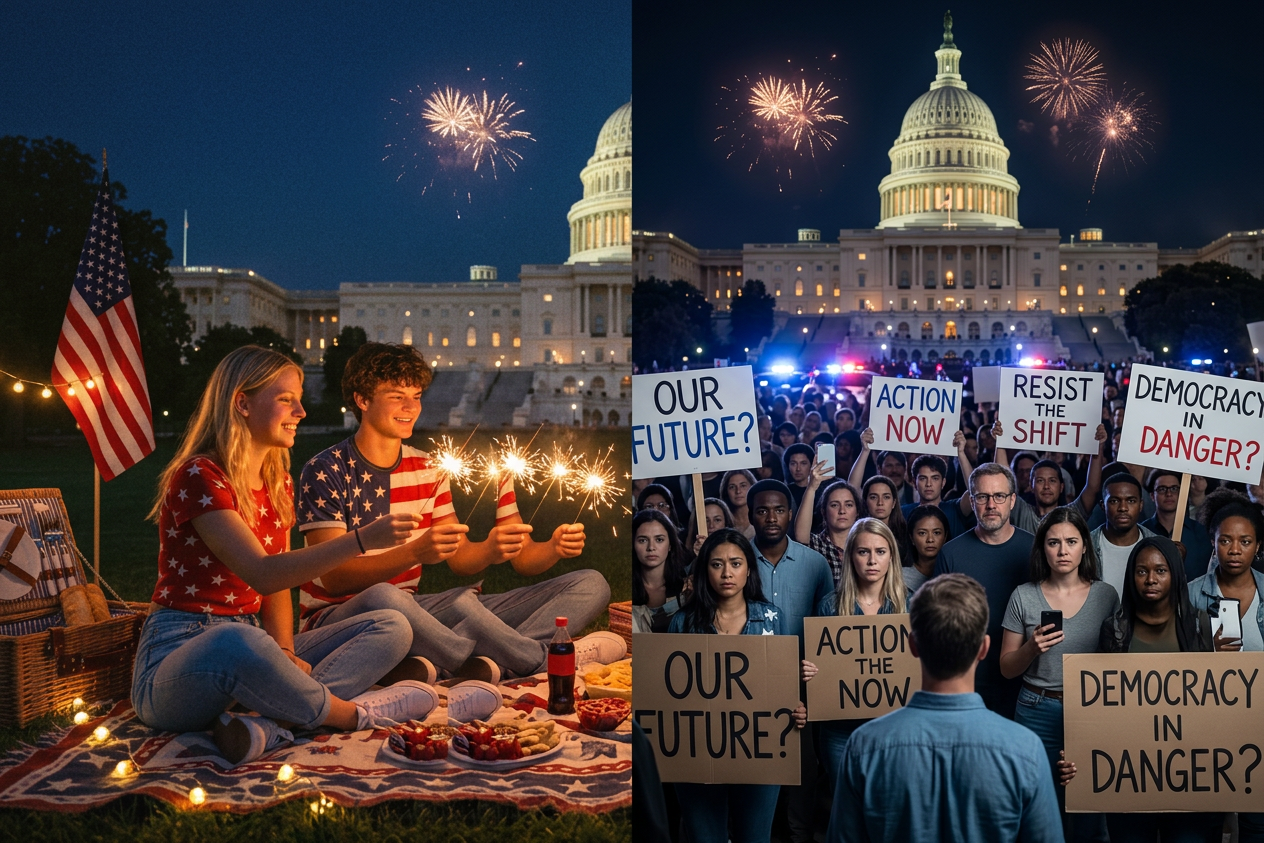
Dear Reader, this is a longer piece. I am working through thoughts that have weighed heavily on my heart as we approach our country’s 250th anniversary.
1976 feels very different from 2026.
I was in my senior year of high school as the calendar turned from 1975 to 1976, our nation’s bicentennial year. “The Spirit of ’76″ became a defining phrase, capturing the mood of that time.
People were excited long before that year started. There were celebrations planned across the country, and it felt like everyone wanted to be part of them. Stores sold all kinds of things to mark the occasion. I bought a 1976 Bicentennial license plate for my old yellow Subaru, which had faded paint and a rust spot above the back wheel. The plate was bright red, white, and blue, and it looked much better in my bedroom than on my unattractive car. So I never put it on the car.
In 1976, Gerald Ford was president. He took over after Richard Nixon resigned because of the Watergate scandal. Nixon’s own Republican Party pushed him to step down for his actions. Ford later pardoned him so the country could move on.
At almost 18, I enjoyed the excitement of the Spirit of ’76 during my senior year. I went to prom, ran track, spent time with friends, and took a weeklong trip to Myrtle Beach after graduation with some girlfriends. Gas cost 62 cents a gallon, so $5 would fill my tank. I didn’t think much about national issues. Politicians were supposed to look out for us; gas was cheap; my parents had steady jobs; and my car took me wherever I needed to go.
Every Fourth of July, we set off fireworks in the field above our house at the end of a dirt road. 1976 was no different. We had friends over, ate hot dogs and hamburgers, swam in the pool, and caught lightning bugs and June bugs. We lit Roman Candles and sparklers, using the sparklers to write our names in the air.
Life was easy, as summer days should be. It truly felt good.
A few years later, I moved into my own apartment and worked full-time. My paycheck was enough for rent, a car, and going out with friends. By 1979, there was a gas shortage. My parents and others were clearly worried. I heard it had something to do with the Iranian Revolution, but I didn’t really understand the details. We could only buy gas on certain days, based on our license plate numbers. My parents traded in the big Pontiac we used for my high school beach trip for a smaller, more efficient car. Families everywhere were switching to smaller cars to save money.
I began seeing the world from an adult’s perspective, worrying if I’d have enough gas to last through a week as I commuted to work.
Jimmy Carter was the first President I ever voted for. He was in office during the gas crisis. It was a tough time for our economy. When he did a televised speech to the nation about saving energy, I could tell he was really worried. He told us to turn off the lights in the rooms we weren’t using. Around the same time, Iran took Americans hostage in November 1979. That event cast a shadow over the country and his presidency. He would lose the chance for a second term to Republican Ronald Reagan.
Reagan liked to show himself as self-sufficient, often pictured at his California ranch in a white cowboy hat, riding a horse. The National Rifle Association, which had previously stayed out of politics, supported him financially. Gun laws got weaker. His vice president, George H. W. Bush, succeeded him but lost after one term, partly because he raised taxes after saying he wouldn’t. Bill Clinton, a Democrat, took office in 1993, made gun laws stricter, and mass shootings decreased. The NRA then worked hard against Democrats in the midterm elections.
In the summer of 1994, I had been married for six years and was pregnant with my first child. I remember sorting baby clothes from a recent baby shower while watching the police chase O.J. Simpson on TV as he sped down a California highway in his white Ford Bronco. He was a famous former NFL player, I’d watched play football and appeared in Hertz commercials for years. He was suspected of killing his ex-wife. I couldn’t help but wonder what kind of world I was bringing my child into.
Little did I know that the event that would capture our attention for months as we watched the trial live on TV was nothing compared to the world that was evolving.
In 1996, the United States hosted the Summer Olympics in Atlanta. It was a year full of celebration, and the excitement reminded me of the bicentennial during my senior year. People near Atlanta felt especially proud. Coca-Cola sponsored the torch relay, and my father-in-law, who used to coach football and track in Coral Gables, Florida, carried the torch through Asheville, N.C. where he and his wife had relocated to. My daughter was two, and my husband’s family was thrilled. We made “Go Ed” signs and cheered him on. He was interviewed by local TV and newspapers several times. It was a proud moment for our family and the country. Life felt good.
In 2001, when George W. Bush was president, terrorists led by Osama bin Laden attacked the World Trade Center and the Pentagon on September 11th. It was a difficult time for the country, but we came together. People bought so many flags there was a shortage. Almost ten years later, in 2011, President Obama announced that U.S. Navy Seals had killed Osama bin Laden in Pakistan. Everyone felt a sense of relief when they heard the news.
Barack Obama became the first Black president in 2009 and served two terms. He took office during the 2008 Great Recession and focused on fixing the economy. He also made health care more affordable. In 2015, the Supreme Court legalized same-sex marriage, and the White House was lit in rainbow colors to celebrate. I was happy for my LGBTQ friends.
When I was growing up in western North Carolina, we didn’t need air conditioning, and my first cars didn’t have it either. Sometimes, when the wind changed, I could smell the papermill from a town away, a reminder of pollution in the river. Hurricanes like Katrina in 2005 seemed to happen more often and cause more damage. Scientists started talking about global warming. As a young adult, I thought politicians were working for us: Nixon started the EPA, Carter created the Department of Energy and supported solar power, Clinton focused on cleaning up toxic sites, and Obama joined the Paris Agreement to cut emissions by 26%. These steps felt like progress for the environment. George HW Bush also supported environmental policies, unlike his predecessor and son, who rolled back policies.
In 2016, Donald Trump ran against Hillary Clinton and won the presidency. He had spent years spreading rumors that Obama wasn’t born in the United States. and was known as a wealthy businessman who had bankrupted several companies, even a casino. He insulted women, people of color, and people with disabilities, and his speeches spread prejudice and hate. These were just some of his negative impacts. His slogan was Make America Great Again, or MAGA. He started dividing the country, separating his supporters from everyone else. He called global warming a hoax and rolled back environmental protections so his billionaire friends could make more money. After he won, it felt like a darkness had falllen over the soul of our country. My husband removed our American flag from our front porch. There was an ample supply available unlike our country’s comraderie after 9/11.
2016 was the first time my daughter could vote. The morning after the election, we stood in our kitchen and cried together. We couldn’t understand how people could vote for someone so hateful and think he’d be good for the country. He hurt many government agencies, including the Centers for Disease Control. Then, in 2020, the pandemic hit the country and the world. 2020 was a horrible year. Trump said early on that it would be over by Easter, but he never said which Easter. It wasn’t until the next year that we started to come out of isolation and stop wearing masks.
Thankfully, Joe Biden was elected to replace him. But Trump, true to form, encouraged a violent mob to storm the U.S. Capitol on January 6th to try to overturn the election. I watched it on TV, and it was AWFUL. Today’s Republicans, unlike those in Nixon’s time, wouldn’t stand up to him and refused to impeach. Some of his supporters, including my local congressman, even claimed the attack was staged by the FBI.
Trump didn’t go away. He kept holding rallies and claiming the election was stolen. After many lawsuits, it was proven over and over that the election was fair. Still, he kept repeating the lie. In May 2023, he was found civilly liable for sexual abuse and had to pay $5 million in damages. In May 2024, he was convicted in New York state court of 34 felony counts for falsifying business records, including paying $130,000 to his former attorney to cover up a payment to an adult-film star for her silence.
Still, in the next presidential election, Kamala Harris, who had been Biden’s Vice President, lost to Trump, even though he was now a convicted felon and rapist. It seems this country just can’t elect a woman. Since coming back, he’s done physical damage to the White House, tearing down the West Wing, pouring cement over the Rose Garden, removing the flowers for a big patio, and threatening to build an arch that would block the view of Arlington National Cemetery. His family businesses are making billions, his tariffs have made prices soar, and his Big Beautiful Bill cut Medicaid, other social services, and veterans’ benefits. He’s also weakened or removed regulations, including OSHA, making workplaces less safe. This is just a small part of the harm he’s caused.
And now here we are, about to “celebrate” July 4th, 2026. It feels like a lifetime since 1976, when life was carefree and we celebrated the country in a big way. Back then, my biggest worry was finding gas during the 1979 shortage, when prices hit $1.25 a gallon. Now, housing is so expensive that even my grown daughter, who earns a good salary, struggles to pay rent. Right now, Trump—who I call the felon in charge—has started an unnecessary war with Iran, and gas prices in the Charlotte area are jumping between $3.50 and $4.90.
Before Trump, July 4th was always a day to celebrate. I won’t be celebrating this 250th anniversary. On top of everything else he’s done, Roe v. Wade has been overturned, and some states are trying to stop women from getting medical care if a pregnancy goes wrong. White Christian Nationalism is growing, and people I call friends are supporting this buffoon.
I’m more involved in politics than I ever imagined. I go to protests, write postcards to encourage people to vote, and attend events to meet candidates and help with campaigns. I even stepped out of my comfort zone to knock on doors for a friend running for Congress. I try to speak the truth to counter all the propaganda, which has gotten worse since Reagan made it possible for Fox News and other so-called news outlets to spread lies and half-truths.
This unexpected activism keeps me busy and connected with others, but it’s not how I pictured my retirement. Still, here I am, like so many others, wondering, “How did we get here? To this?”
Now that I’ve written it all down, I can see a lot of the path that led us here.
When I was younger, I believed our leaders wanted the best for everyone and that we were always trying to improve, no matter the political party. We weren’t blue versus red or Democrat versus Republican, we were Americans. I don’t see that kind of leadership now. And this country is very divided between MAGAs and all others. How can we ever get back to those times when we felt hopeful and safe, even if things weren’t perfect?
How indeed. The only answer I have, that I repeat to others, is
Vote blue or lose.

